
Best Combi Boiler for a Condo Townhouse in Toronto: A Buyer’s Guide


If you own a condo townhouse in Toronto, you already know the constraints that come with it: a small mechanical closet instead of a basement, shared walls that make noisy equipment a real problem, and often a condo corporation that has opinions about what you can install and how. So when someone asks "what's the best Combi Boiler for a Toronto Condo," the honest answer isn't a single model name it's the boiler that fits your unit's space, your household's hot water demand, and your building's venting and approval rules. This guide walks through what actually separates a good fit from a bad one, and where some well-regarded brands land.
Why Combi Boilers Suit Condo Townhouses in the First Place
A combi boiler handles space heating and domestic hot water from one compact wall-hung unit, with no separate storage tank and no floor-standing furnace footprint. That matters a lot in a townhouse where the mechanical room might be a closet barely large enough for the equipment already in it. It also matters for hot water: on-demand heating means you're not limited by tank size, which is useful in a two- or three-bedroom townhouse where more than one person might want a shower around the same time.
That said, "space-saving" doesn't automatically mean "best for you." A combi boiler still needs to be sized correctly, vented properly through an exterior wall, and matched to your actual heating load and that's where a lot of installations go wrong.
What Actually Determines the Right Boiler
Before comparing brands, it's worth being clear about the factors that matter more than a nameplate:
- Sizing (BTU output). An oversized boiler short-cycles, wastes energy, and wears out components faster. An undersized one can't keep up on a cold January night or leaves you with lukewarm water when the heat is also calling. Proper sizing depends on a heat loss calculation for your specific unit square footage, insulation, window exposure, and ceiling height — not a rule of thumb based on the boiler that worked for your neighbour's unit, which may be a different model of townhouse entirely.
- Efficiency (AFUE). Modern condensing combi boilers commonly reach the mid-90s to upper-90s percent AFUE range, meaning very little of the fuel's energy is lost up the vent. Canada's federal efficiency rules have been tightening over the past several years, phasing out older non-condensing (atmospheric) boiler designs in favour of condensing units for new residential installations — so almost anything installed new today will already be a high-efficiency condensing model. The real question is how that efficiency holds up under your household's actual usage pattern, which a qualified installer can help estimate.
- Venting. Combi boilers vent horizontally through a wall rather than up a chimney, which is convenient until you check where that wall faces relative to windows, walkways, neighbouring units, and your municipality's clearance rules. In a townhouse row, vent placement is one of the more common reasons an installation gets flagged or delayed.
- Noise. Attached walls mean equipment noise travels. Some units run notably quieter at low fan speeds than others, which is worth asking about if your mechanical closet backs onto a bedroom.
- Warranty and parts availability. A boiler is a 10-to-15-year-plus purchase. A brand with a strong local network of technicians and available parts matters more over that time than a marginal efficiency difference on the spec sheet.
- The installer. Two identical boilers installed by different contractors can perform very differently. Correct sizing, venting, condensate drainage, and gas line sizing are all installer-dependent, not boiler-dependent.
A Look at Some Well-Regarded Combi Boiler Brands
Several manufacturers have a solid track record in the Canadian residential market and show up often in condo and townhouse installations. This isn't a ranked "best" list it's an honest look at what each tends to be known for, so you can weigh them against your own priorities.
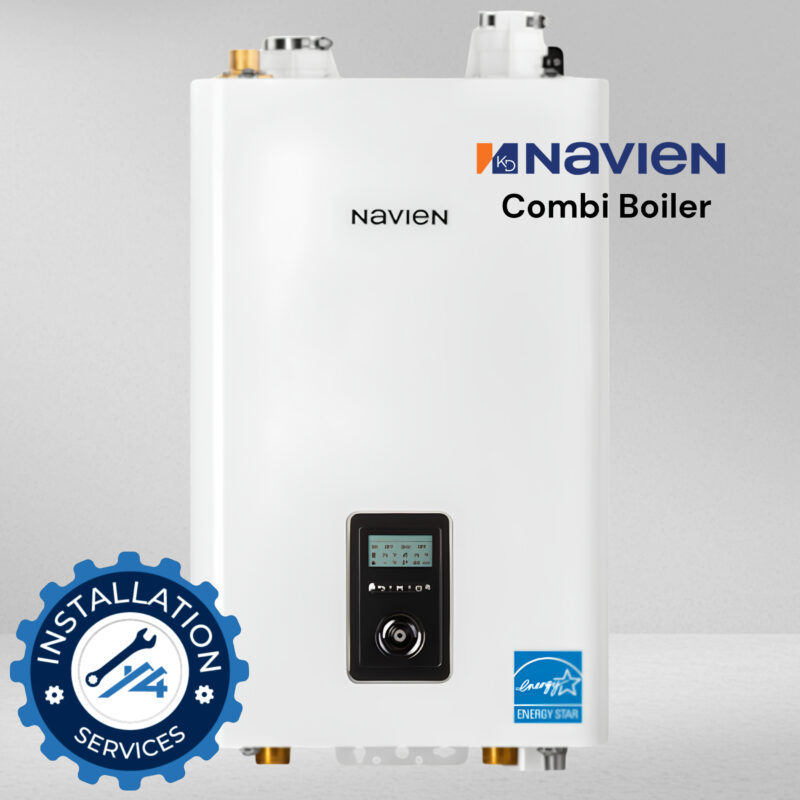
Navien is widely used in Canada and known for features like high turndown ratios (allowing the burner to modulate down for smaller loads efficiently), built-in filtration options to protect the heat exchanger, and app-based monitoring on higher-end models. Typical coverage in this class runs around five years on parts and up to a decade on the heat exchanger, though exact terms vary by model and should be confirmed at purchase.
Rinnai offers compact combi models designed with tight mechanical spaces in mind, with output ranges spanning smaller BTU tiers up to larger ones so a unit can be matched more precisely to a compact townhouse's heating load rather than over-sized by default.
Specific pricing, warranty terms, and available models change over time and by supplier, so treat any figure you see quoted including anywhere on this page as a starting point to confirm directly with the manufacturer or your installer rather than a locked-in number.
Getting an Honest Assessment
The "best" combi boiler for your condo townhouse comes down to a heat loss calculation for your specific unit, an honest look at your mechanical room's constraints, and a venting plan that satisfies both the manufacturer's requirements and your building's rules not a brand name alone. If you're weighing options or trying to figure out whether your current unit needs repair or replacement, 4Most Energy can assess your space, your equipment, and your comfort needs, and help you choose a solution that actually fits.
Condo and Townhouse Installation Considerations
Beyond the boiler itself, a few things are specific to multi-unit and townhouse living:
Mechanical room clearances. Manufacturers specify minimum clearances around a wall-hung unit for service access and combustion air. In a tight closet already sharing space with an electrical panel or laundry equipment, this can rule out certain models before efficiency or price even enters the conversation.
Condo corporation or property management approval. Many condo townhouse complexes require sign-off before mechanical equipment is replaced, particularly where venting penetrates a shared exterior wall or the work touches common-element plumbing or gas lines. Check your declaration and rules, and budget time for approval before assuming an install date.
Existing infrastructure. Gas line sizing, water pressure, and the condensate drain path were all designed around whatever was originally installed. A straightforward like-for-like replacement is usually simpler than switching to a different boiler category or a significantly higher-output unit, which may require line upgrades.
A licensed installer. Gas-fired heating equipment in Ontario must be installed by a contractor properly licensed for gas work, consistent with Technical Standards and Safety Authority (TSSA) requirements. This isn't optional paperwork it affects your insurance, your warranty validity, and your safety.
How 4Most Energy Helps With Condo Townhouse Combi Boilers
Everything above is the framework here's how it plays out when 4Most Energy is the one handling your project:
Sizing. Rather than defaulting to a standard output because "that's what most townhouses use," our technicians run a heat loss calculation specific to your unit before recommending a BTU range, so you're not paying to heat capacity you don't need or living with one that can't keep up.
Brand and model selection. We work across the major combi boiler lines discussed above Navien, Rinnai,... among them so the recommendation is based on which unit actually fits your mechanical closet, venting path, and household hot water demand, not on a single line we happen to carry.
Venting and condo approval. We look at your wall orientation, clearance to windows and walkways, and municipal requirements up front, and can provide the documentation condo boards or property managers typically ask for before sign-off so approval isn't the thing that stalls your project after the boiler's already been ordered.
Licensed gas work. Installation and any gas line changes are carried out to TSSA requirements for gas-fired heating equipment, which protects your insurance standing and keeps your manufacturer's warranty valid.
Repair-vs-replace guidance. If your current combi boiler is acting up, we'll give you a straight answer on whether it's a diverter valve, sensor, or pressure issue worth repairing, or whether the unit's age and condition make replacement the better long-term value without steering you toward replacement by default.
Rebate guidance. Because Ontario's rebate programs shift often, we keep track of what's currently available for heating equipment upgrades and can tell you at the time of your project whether anything applies, rather than leaving you to chase down outdated program details.
Ongoing maintenance. Once a new unit is in, our maintenance plans help protect that AFUE rating and the manufacturer's warranty over the 10-to-15 years you'll likely own it.
Repair or Replace? Don't Assume It's Time for a New Unit
Not every combi boiler issue means replacement. Common, repairable problems include low system pressure, a faulty diverter valve, sensor faults, or mineral buildup affecting flow — all of which a technician can typically address without swapping the whole unit, especially if the boiler is under 10 years old and has been reasonably maintained.
Replacement becomes the more sensible path when the heat exchanger itself is failing, when repair costs start approaching a meaningful fraction of replacement cost, when the unit is old enough that parts are getting hard to source, or when efficiency losses from an aging non-condensing unit are costing more in fuel than a new condensing model would over a few years. If you're not sure which category you're in, that's a question worth getting an honest answer to before committing either way.
FAQs
Is a combi boiler a good fit for a small condo townhouse mechanical room?
Generally yes combi boilers are compact, wall-hung units with no separate storage tank, which is exactly the space profile most condo townhouse mechanical closets are built around. The unit still needs to meet the manufacturer's minimum clearance requirements, so it's worth measuring your space before shopping by brand.
What size combi boiler do I need for a townhouse?
It depends on a proper heat loss calculation for your specific unit factoring in square footage, insulation, window area, and ceiling height rather than a general rule of thumb. An oversized or undersized boiler both cause problems, so this is worth having a technician calculate rather than guessing.
Do I need condo board approval to install a new combi boiler?
Often, yes, particularly if the work involves venting through a shared exterior wall or touches common-element gas or plumbing lines. Check your condo declaration and rules, and factor approval time into your project timeline.
How long does a combi boiler typically last?
Most well-maintained combi boilers last somewhere in the 10-to-15-year range, sometimes longer, depending on water quality, usage, and how consistently the unit is serviced.
Can I switch from a boiler-and-tank system to a combi boiler in my townhouse?
Often, but it depends on your existing gas line sizing, water pressure, and how the new unit's hot water output compares to your household's needs. A technician can assess whether your current infrastructure supports the switch or needs upgrades first.
Are there current rebates for high-efficiency boilers in Ontario?
Rebate programs change fairly often. Enbridge Gas's Home Efficiency Rebate Plus program has closed to new applicants, so current options are worth confirming directly with Enbridge Gas, Save on Energy, or your installer at the time you're planning your project.
Not Sure What You Have?
You can usually confirm your model by opening the lower access panel of your unit (behind the return air grille) and checking the manufacturer label for the model and serial number. If you're not sure, send us a photo we'll identify your unit and confirm compatibility before you commit to anything.
Ready for a quote? Call or WhatsApp 4Most Energy to speak with a condo heat pump specialist, or upload a photo of your existing unit through our online form. GTA customers get a same-day quote including professional installation and a 1-year labour warranty; customers outside the GTA can order equipment for shipping and arrange local installation.
Request Your 20-Minute Estimate
Our Heat Pump expert will review your info, prepare an official estimate, and contact you within 20 minutes